Dolby Home: Interactive Buyers Guide
A guided, image-driven tool that helps users easily find the right Dolby-enabled devices for their unique room and setup. I led design exploration and user research synthesis to simplify a highly technical shopping journey into an intuitive, confidence-building experience.
Overview
The Interactive Buyers Guide is a guided, image-forward flow that helps users co-create their ideal entertainment setup step-by-step. Working on the Interactive Buyers Guide (IBG) was uniquely nostalgic. When I was young (and before we had internet), I spent hours in our computer room making interactive PowerPoints. I created pseudo-animations by treating slides like a flipbook and built faux-buttons that guided people from one page to the next. Years later, I found myself using the same scrappiness to create low-development interactions for the IBG. This project reminded me that creativity often emerges from constraints, and that playful experimentation can have real impact even in highly technical flows. It also challenged a core assumption we held early on. The initiative was initially called “Living Room,” based on the belief that people primarily enjoy entertainment in one central space. Research quickly revealed how varied real households are: different rooms, different set-ups, and different needs coexist even within a single home. This shift broadened our empathy and became fundamental to how we shaped the IBG.
The Design Challenge
Consumers often struggle to understand which devices support the entertainment experience they want. Technical terminology, platform jargon, and marketing language overwhelmed users instead of helping them. Our challenge:
Context + My Role
I partnered with another designer to develop multiple features across Dolby Home, one of them being the IBG. Under the guidance of our Design Lead, we collaborated closely with creative teams, developers, and researchers to create a guided web experience that helps entertainment enthusiasts make informed purchasing decisions with confidence and clarity.
Process
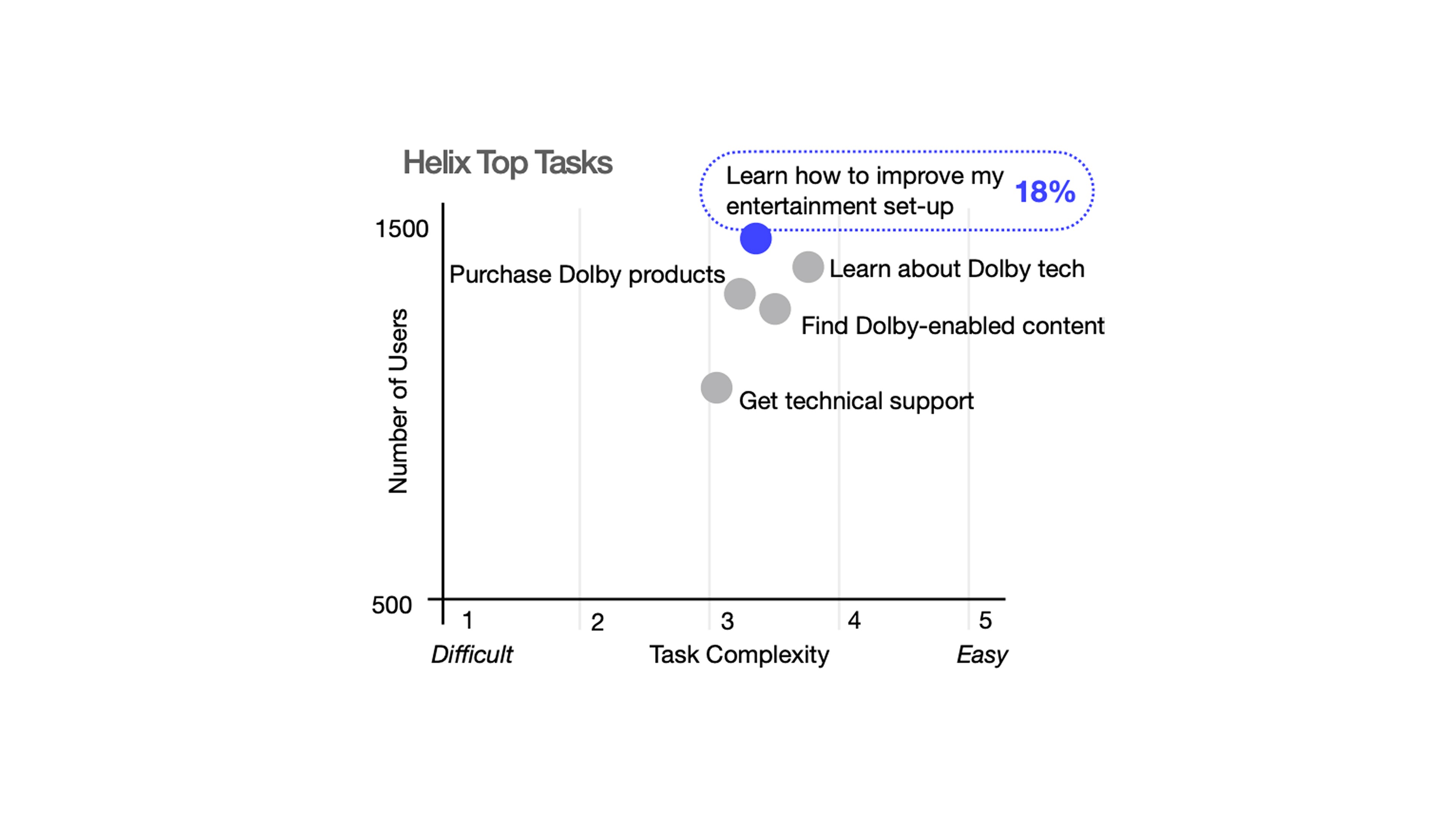
We began with CX insights showing that visitors most often came to the site to improve their set-ups, followed closely by device research tasks.
To build a deeper understanding, we conducted research sessions with individuals across demographics, entertainment habits, and tech fluency. All participants were active home entertainment shoppers, many of whom were Dolby-curious but lacked technical expertise.
We identified a primary persona:
People who want an elevated entertainment experience at home, but want the process to be easy and intuitive.
This is best summarized by one participant who stated:
“I just want something that’s easy and integrated and functional, but gives you that ‘wow experience’ without having to get a degree in audiovisual set-up.
Key findings
Users felt overwhelmed by too many options.
Their highest priority was reduced complexity.
They wanted personalized recommendations based on their setup and criteria. (13/16 strongly agreed.)
They wanted to “co-create” their ideal setup by entering their room and preferences. (12/16 said this was essential.)
Our early assumption about “the living room” was incorrect, as users enjoy entertainment across multiple rooms with different layouts and use cases.
This shaped our MVP features:
A landing page that orients users on the value of Dolby and the IBG
A results page that displays device recommendations
A guided set of need-based questions (broad → narrow) that help refine recommendations
Iteration
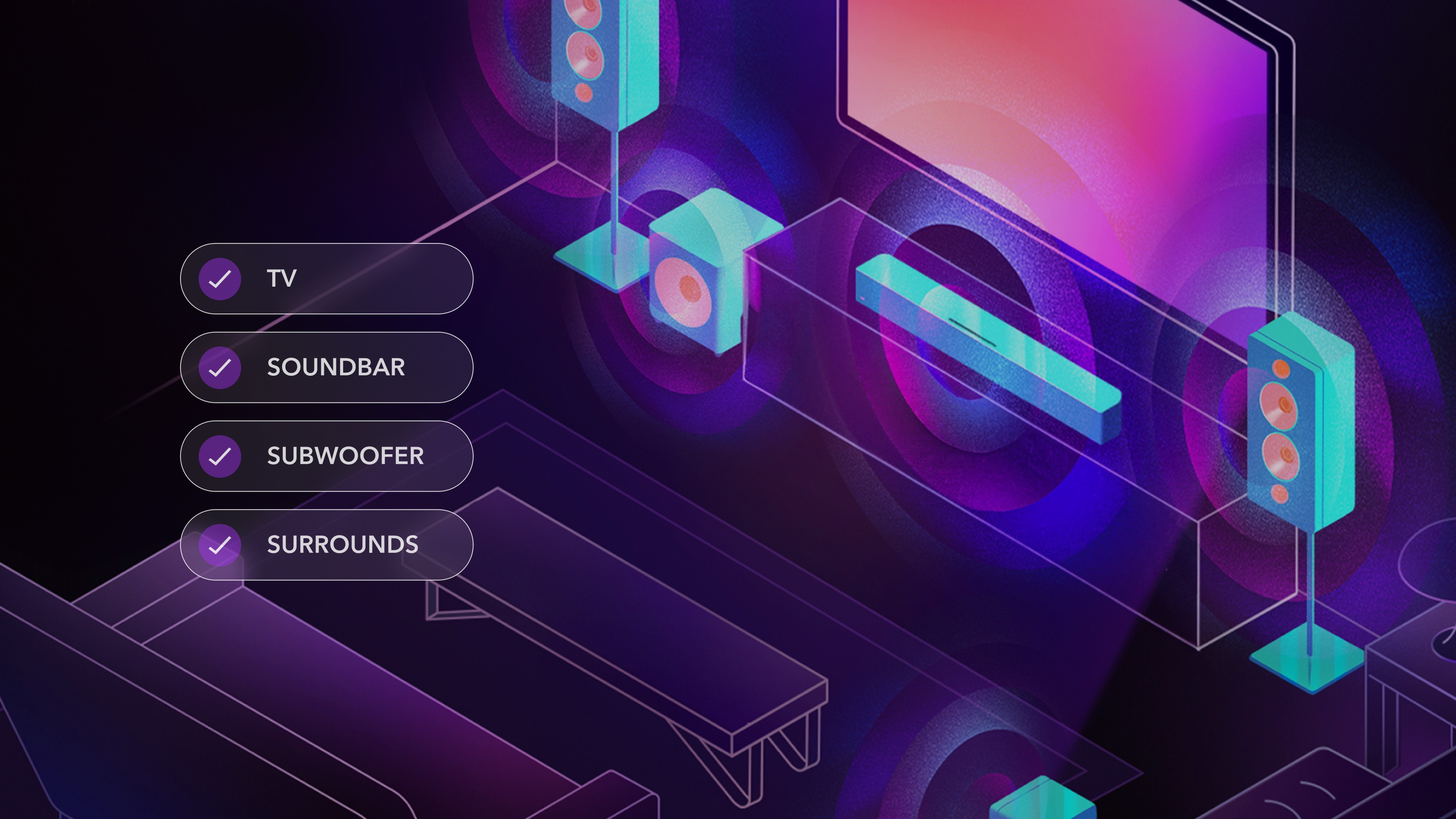
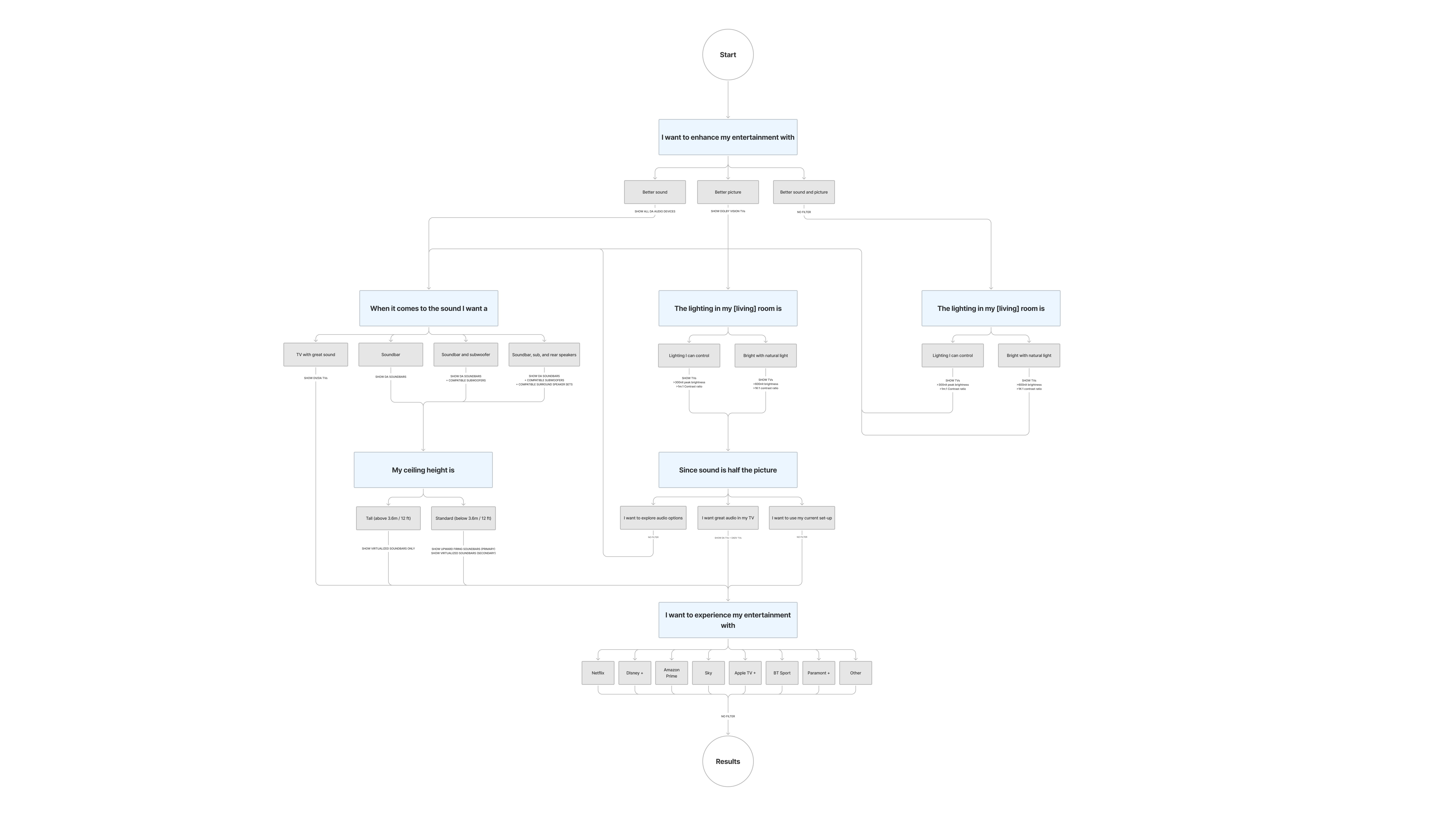
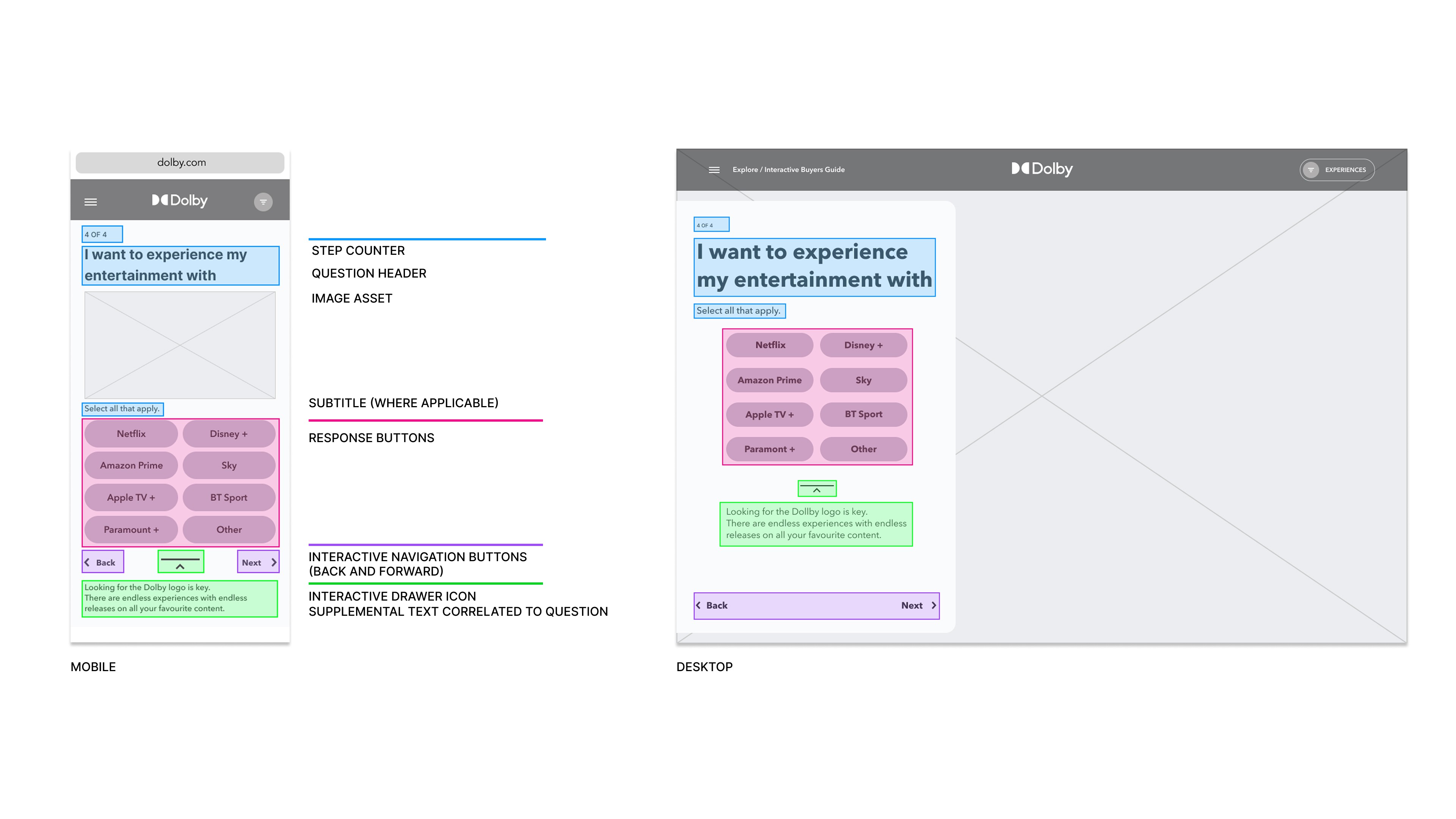
With these insights, I began by analyzing other guided recommendation tools, particularly those for physical products (e.g., furniture, bedding, sound equipment). I noticed variations in use of imagery, from tools that featured the product in a simulated environment to those that relied primarily on iconography. Inspired by this range, I generated as many layouts as possible, including ones I knew wouldn’t work. I often find that if I aim to create 40 iterations, the 41st is where something original emerges. For our use case, showing a room simulation felt most aligned with user needs. Since users were designing for their unique space, the imagery helped anchor them in the mindset of imagining the room they were improving. I collaborated closely with the creative team to produce images that supported our layouts, where the question prompts and answer options were thoughtfully overlaid on the visual. Applying my experience with interactive presentations, I created an illusion of interactive graphics by illuminating different areas of the room depending on which answer option they select. In parallel, I collaborated deeply with engineering to design the filtering logic. Each question functioned as a backend filter, narrowing recommendations progressively. To avoid prematurely eliminating devices, we prioritized a “broad to narrow” approach and cross-referenced all filters against available metadata. We also worked closely with copywriters to define the supplemental copy for each question. We sought to balance education with simplicity, and explored the concept of hiding and revealing copy. A key design principle was: Make the experience feel light, focused, and unintimidating. After wireframes, we tested with participants matching our persona. We learned: - Users fully understand the purpose of the tool, and find the notion of completing a quiz to get personalized recommendations appealing as well as find it useful to supplement their research. - Users appreciate and enjoy the interactive graphics which add an entertaining feel to the experience. - The objective of the subcopy determines what users view as the ideal interactions and placement. For example, if the purpose is to explain why we ask a particular question, users prefer the copy to be always on, and appear before they select an answer. This feedback guided refinements to copy tone, button labels, and the order of questions to maximize ease and clarity.
Solution
Key elements of the final design: On the landing page, we introduced the value of Dolby and explained how the IBG works, setting clear expectations before users began the journey. Then in the question flow, each question appeared over a stylized room environment, helping users visualize how their choices would shape their actual space. We minimized cognitive load by presenting one question at a time with a focused, conversational tone. The journey ended on the results page. This page started with a hero banner with an archetype that encompasses the user’s results to align with the quiz concept, simple key specs explaining explanations for why each device was recommended, and a curated list of recommended devices, each linking to respective product pages to learn more about the product and where to buy.
Reflection
This project taught me the importance of designing for real contexts rather than assumed ones. Something as simple as realizing people watch movies in spare rooms, basements, and bedrooms (not just the “living room”) reshaped our entire approach. I also learned how much creativity can emerge from constraints. Working within a rigid backend metadata system pushed me to think playfully again, much like my childhood PowerPoints crafting interactions that felt simple, intuitive, and delightful on the front end despite the technical complexity behind the scenes. Finally, IBG reinforced how much I value cross-functional problem-solving. The best parts of this project came from deep collaboration with engineers, researchers, and creatives, each shaping the final experience in ways no one discipline could have done alone.